
 Ruchi Verma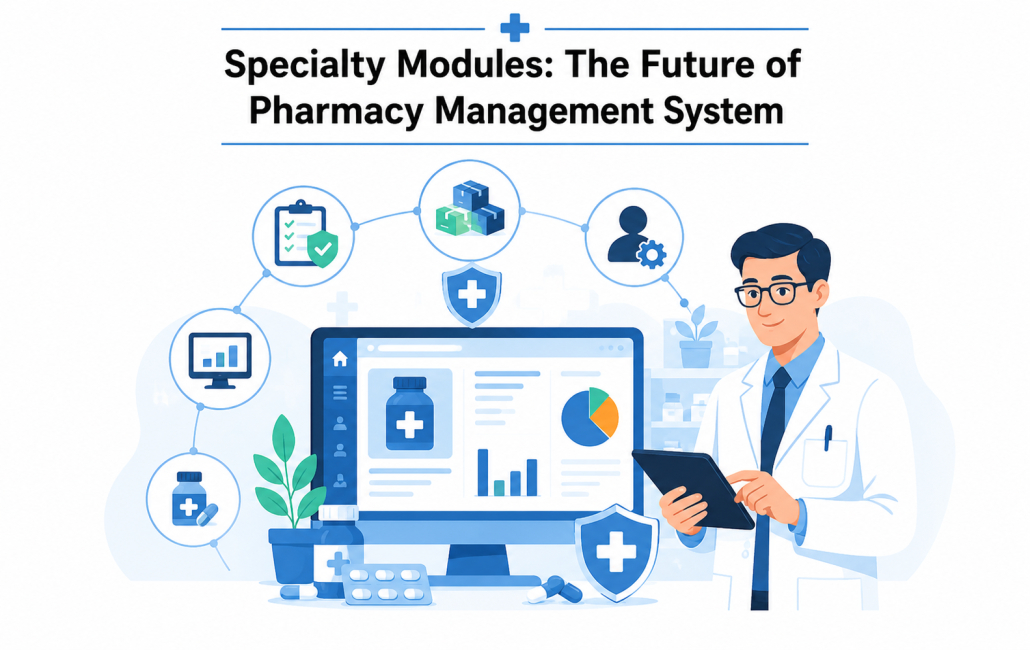
Healthcare is making rapid strides towards digital revolution and health systems’ operations are increasingly complex. Traditional dispensing systems are transforming to intelligent platforms that facilitate clinical care, optimize inventory management, engage patients, and help ensure compliance with regulations. The introduction of the modern Pharmacy Management System at the middle of this development, accompanied by unique modules to fulfill particular needs of specialty medical services, represents the core of this evolution.
The healthcare sector is a world of cutting-edge technology, and pharmacies can’t be satisfied with just making copies.Transforming healthcare commerce by incorporating improved technologies, pharmacies require more than just a photocopier. They need detailed Pharmacy Software Solutions that make processes more efficient, patient care better, and are able to adapt to the changing needs of healthcare providers. Specialty modules are the next in line of innovation where they can assist pharmacies in providing a customized service without compromising the efficiency and profitability side.
Understanding Specialty Modules in Pharmacy Technology
Specialty modules are additional components that are included within a Pharmacy Management System to handle special healthcare-related activities that go beyond the typical dispensing and inventory management. These modules help pharmacies grow and meet their complex clinical, operational and financial needs.
With traditional stand-alone applications, they struggle to integrate with existing software solutions and limit the functionality of the systems they are built on. Specialty modules of the kind exist with the ability to naturally and seamlessly integrate along with the current software solution available for a pharmacy, thereby forming a single ecosystem for e-pharmacy operations.
Some of the specialty modules are:
- Medication Therapy Management (MTM)
- Oncology Pharmacy Management
- Specialty Drug Tracking
- Comprehensive Home Healthcare Assistance in the field Pharmacies
- Clinical Decision Support Tools
- Patient Adherence Monitoring
- Telepharmacy Services
- Prior Authorization Management
These additional features will enable pharmacies to provide a more personalised healthcare experience for their patients, while also streamlining the facilities and optimising their operations.
Why Specialty Modules Are Becoming Essential
Healthcare is transitioning to value-based care approaches focused on outcomes as opposed to volume. This change increases the role of pharmacies in active involvement of patients in treatment management and patient monitoring.
Advancements in Pharmacy Software enable pharmacists to change the traditional role of handing out medications and connect with various players in the health care sector as an essential part of accessing patient care.
There are a number of reasons driving specialty modules:
As the occurrence of chronic disease grows, there is also greater need for chronic disease medications. There is a high need for specialist medications to be monitored and for a dosage adjustment and patient counselling.
Accurate documentation, audit trails, and reporting are required in redlined areas to meet increasingly strict regulatory demands.The market is demanding more accurate documentation, audit trail and reporting capabilities to meet increasingly strict market requirements. Compliance to the specialty modules is supported and administration is promoted with the help of integrated specialty modules.
Patients also demand convenience and better individualisation in both the treatment that is delivered and the process (how it is received). Patient consultation via remote technology, adherence and reminder functions improve patient engagement and satisfaction.
Innovativeness in Pharmacy Healthcare Software Solutions is increasingly fast becoming a key strategic move for any Pharmacy aiming to gain a competitive edge.
The Role of AI and Analytics in Specialty Pharmacy Modules
AI is reshaping the pharmacy technology landscape with its advancements in predictive analytics and intelligent decision-making. AI is revolutionizing pharmacy technology, introducing smarter capabilities and decision-making powers. AI-driven specialty modules can analyse vast amounts of data to uncover trends, identify and optimise drug use, and enhance patient outcomes.
Capability of advanced analytics can enable pharmacists to calculate if a medication event may have caused a patient to be at risk of non-adherence in order to address it as early as possible in a strategy to prevent complications. Recommendations made by AI can also help guide clinicians in choosing the best treatments for each patient based on their treatment protocols and patient characteristics.
An algorithm that works on the principle of machine learning can predict the requirements for inventory and limit the wastage and stocks shortages. For specialty medicine products, which often are costly to acquire and have short shelf lives, this is a great plus.
Intelligent Pharmacy Software Solutions have the hard task of increasingly taking shape as a key part of healthcare organizations’ efforts to provide efficient and personalized pharmaceutical care.
Specialty Modules Enhancing Financial Performance
Sustainability in the financial aspects in highly competitive pharmacy settings is key. Leveraging specialty modules that are often easily connected with billing software for pharmacies can help optimize the revenue cycles and improve reimbursement processes in the healthcare industry.
When handling specialty medication development, infusion medications, and chronic disease programs accurate billing is critical. With automated claims processing, there are fewer mistakes and faster claims cycles which translates to being able to manage cash flow even better.
Current medical billing software for the pharmacy industry can solve several payer contracts, electronic claims filing and denial management procedures. These features enable pharmacies to get maximum reimbursement opportunities and reduce the workload of manual administrative tasks.
Additionally, the integrated billing offerings give managers on-the-spot financial information, helping them to track profitability of various services and patient groups. The advantage of healthcare businesses that have medical specialty care modules along with cutting-edge billing technologies is undeniable in the long haul.

Supporting Healthcare Providers Through Integrated Systems
The pharmacist is becoming more involved in the care of a patient in collaboration with the physician, nurse, and other clinicians. Specialty modules offer a positive way to make these connections with enhancements to communication and data sharing between healthcare providers.
Pharmacists can view the lab results, treatment histories and medication records within their workflows via integrated systems. This all-encompassing picture helps the clinic make decision-making and takes down any threats associated with medicines.
Secure messaging is possible which helps health care providers to communicate effectively, about treatment changes, bad effects, and patient outcomes.
Healthcare software in the contemporary times plays its role in ensuring safer and effective healthcare delivery through its partnerships with the other disciplines.Therefore, modern healthcare software plays a part in the healthcare delivery of the present-day, ensuring a safe and effective healthcare, as it promotes an interdisciplinary collaboration.
Read : Next-Gen Lab Operations
The Rise of Specialized Pharmacy Services
Specialty pharmacy services are continuing to grow to meet the increasingly complex needs of consumers and developments in pharmaceutical research. Highly specialized workflows are required across various fields like oncology, rheumatology, infertility, rare disease management, etc.
A good Pharmacy Management System can complement these services, and can be customized with additional specialty modules for each of these therapeutic areas.
For instance, oncology modules might consist of chemotherapy regimen validation, dosage calculation, toxicity monitoring and chemotherapy scheduling modules. Fertility pharmacy modules can be based on tracking and counseling on hormone therapy provided to the patients.
Valuable capabilities in telepharmacy are also getting adopted especially in rural and under-served areas. Virtual review and consultations provide greater access to pharmaceutical expertise, and decrease burden of travel for patients.
The innovations reflect the evolving requirements of modern health care physical organizations that have to be enormously adaptable and versatile.
The Growing Importance of Pharmacy Technology in India
Digital pharmacy solutions are becoming the norm in and across emerging health care markets. Over the years, the need for a robust and reliable Pharmacy Management System In India has increased manifold, as hospital, retail pharmacy, and specialty clinic businesses are desperate to enhance their efficiency and patient care values.
Healthcare Providers suffer issues with growing numbers of patients, regulatory compliance and access to medications in India. Specific modules deliver scalable answers that enable pharmacies to contain service high quality and offer solutions to this dilemma.
Cloud-based deployments are more appealing for their ability to reduce the cost of infrastructure, while allowing for secure access to information from any on-premises location.
The ongoing digital transformation movement across the nation indicates that the investment in advanced Pharmacy Software can be poised to play a crucial role in bringing a boost to healthcare modernization in the country.
The Future of Specialty Modules in Pharmacy Technology
The future of pharmacy technology will be intelligent and interconnected modality that’ll facilitate tackling the multi-facet clinical and operational requirements. Specialty modules will also become more crucial to helping pharmacies offer all-encompassing, patient-centered care.
The use of emerging technologies like artificial intelligence, predictive analytics, integration with wearables, and blockchain security systems will continue to further improve the capabilities of pharmacies. All of these innovations will provide increased opportunities for pharmacies to provide high quality care in a more efficient way.
Integrated with advanced Pharmacy Software Solutions, these organizations can develop better specialty modules and Pharmacy Billing Software solutions to address the needs of the healthcare industry, which is undergoing transformation.
However, the future of pharmaceutical care will be governed by the specialty modules, which will be a part of the latest Pharmacy Management System platform, and this will help the pharmacies to further improve the clinical impact, finances, and outcomes for patients globally.
Final Thoughts
Important modules that specialize in certain aspects of healthcare are changing the future of pharmacy technology, empowering pharmacies to go beyond merely dispensers to play meaningful roles in delivering patient-centered care. These innovations are driving a transformation of how pharmacies deliver care within the health care landscape, whether it’s through advanced clinical services, telepharmacy options, or intelligent analytics and streamlined billing processes.
A solid Pharmacy Management System, along with the Pharmacy Billing Software and a scalable Pharmacy Software Solutions approach can help increase efficiency, optimize patient outcomes and foster better collaboration within the healthcare sector. In the era of accelerated digital transformation, companies will have to continuously invest in electronic health records and specialty-specific technology solutions to ensure their operations continue to be efficient and to achieve long-term growth and success.
© Ruchie Verma
Disclaimer: The information provided is not intended to provide diagnosis, treatment, or individual medical advice. It is provided for informational purposes only. Please consult with the physician or other healthcare professionals regarding any medical or health-related diagnosis or treatment options.