 Ruchi Verma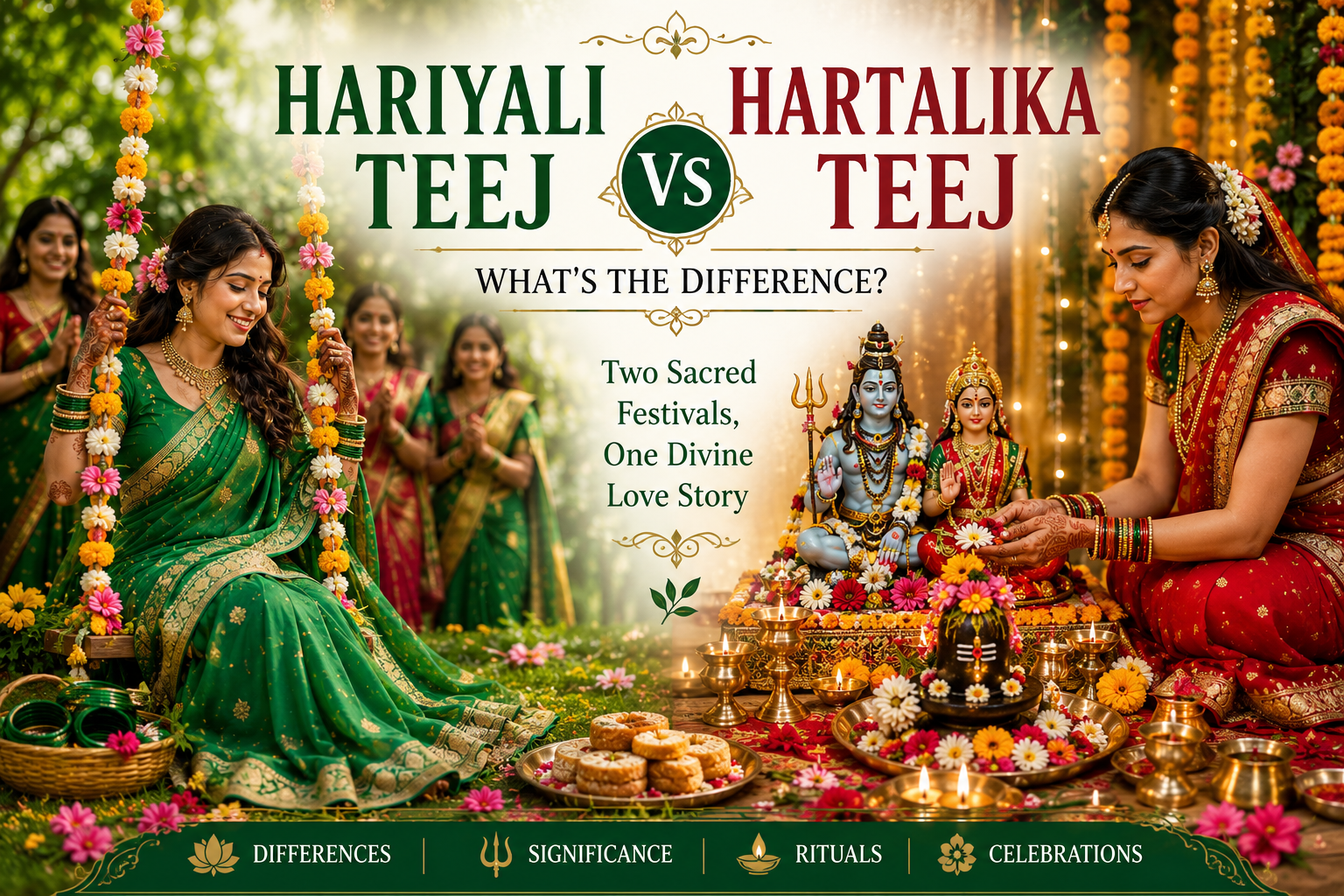
Every year during the monsoon season, many people search online to understand the difference between Hariyali Teej and Hartalika Teej. Since both festivals are dedicated to Lord Shiva and Goddess Parvati and are observed mainly by women, it is easy to assume they are the same. However, these festivals differ in their timing, significance, rituals, fasting traditions, and regional celebrations.
If you’ve ever wondered which Teej comes first, why there are multiple Teej festivals, or how Hariyali Teej differs from Hartalika Teej, this guide answers all your questions in simple language.
Whether you are observing the festival for the first time or simply want to understand its cultural significance, this article will help you learn everything about these beautiful Hindu festivals.
The difference
Hariyali Teej and Hartalika Teej are two different Hindu festivals dedicated to Lord Shiva and Goddess Parvati. Hariyali Teej is celebrated during the month of Shravan to mark the reunion of Shiva and Parvati and the arrival of the monsoon. Hartalika Teej is observed later during Bhadrapada and commemorates Goddess Parvati’s deep penance before marrying Lord Shiva. While both involve fasting and prayers, their rituals, significance, and celebrations are different.
Hariyali Teej vs Hartalika Teej
| Feature | Hariyali Teej | Hartalika Teej |
|---|---|---|
| Meaning | “Hariyali” means greenery, symbolising the lush monsoon season and the joyful reunion of Lord Shiva and Goddess Parvati. | “Hartalika” comes from the Sanskrit words “Harit” (to abduct) and “Aalika” (female friend), referring to Goddess Parvati’s friend taking her away to continue her penance. |
| Celebrated In | Shravan (Sawan) month during the monsoon season. | Bhadrapada month, around a month after Hariyali Teej. |
| Main Significance | Celebrates the reunion of Lord Shiva and Goddess Parvati after years of penance. | Commemorates Goddess Parvati’s unwavering devotion and penance before her marriage to Lord Shiva. |
| Festival Theme | Love, happiness, prosperity, greenery, and marital bliss. | Faith, determination, sacrifice, devotion, and spiritual strength. |
| Mythological Story | Marks the divine reunion of Shiva and Parvati after Parvati’s penance was accepted. | Marks the time when Parvati’s friend secretly took her to the forest, where she continued her penance and worshipped Shiva with a sand Shivling. |
| Purpose of the Vrat | Married women pray for the long life and happiness of their husbands. Unmarried women seek an ideal life partner. | Married women pray for marital harmony and family well-being. Unmarried women seek blessings to marry a virtuous husband like Lord Shiva. |
| Type of Fast | Varies by family tradition. Some observe a complete fast, while others consume fruits or milk. | Traditionally observed as a strict Nirjala Vrat (without food or water) in many communities, though customs may differ. |
| Primary Deities Worshipped | Lord Shiva and Goddess Parvati. | Lord Shiva and Goddess Parvati. |
| Traditional Attire | Green sarees, lehengas, glass bangles, floral jewellery, and mehndi. | Green or red sarees with traditional jewellery and bridal-style adornments. |
| Importance of Green Colour | Represents prosperity, fertility, happiness, and the beauty of the monsoon. | Green signifies prosperity, while red symbolizes marital bliss, strength, and devotion. |
| Major Rituals | Mehndi application, swings (jhoola), folk songs, Shiva-Parvati Puja, exchanging gifts, and festive gatherings. | Nirjala fast, making a sand or clay Shivling, Shiva-Parvati Puja, listening to the Hartalika Vrat Katha, and night-long prayers. |
| Traditional Foods | Ghevar, Malpua, Kheer, Rabri, Puri, Aloo Sabzi, and seasonal sweets after the rituals. | Devotees generally eat only after completing the fast according to family customs. Festive meals vary by region. |
| Celebration Style | Colourful, festive, joyful, and social with family gatherings. | Quiet, spiritual, devotional, and focused on worship and meditation. |
| Popular States | Rajasthan, Haryana, Delhi, Uttar Pradesh, Punjab, and parts of Madhya Pradesh. | Maharashtra, Bihar, Uttar Pradesh, Madhya Pradesh, Jharkhand, Chhattisgarh, and Nepal. |
| Special Traditions | Decorated swings, traditional folk dances, songs, and gifts from parents to married daughters (Sindhara). | Women stay awake through the night singing devotional songs and praying to Lord Shiva and Goddess Parvati. |
| Who Celebrates? | Married and unmarried women. | Married and unmarried women. |
| Symbolic Objects | Swings, green bangles, mehndi, flowers, and greenery. | Shiva Lingam, clay idols, kalash, diya, bilva leaves, and sacred offerings. |
| Spiritual Message | Love blossoms through patience, trust, and mutual respect. | Determination, unwavering faith, courage, and devotion lead to divine blessings. |
| Which Festival Comes First? | First Teej festival of the monsoon season. | Celebrated after Hariyali Teej. |
| Overall Essence | A celebration of divine love, nature, and family togetherness. | A celebration of devotion, self-belief, spiritual discipline, and the power of sincere prayer. |
| Choose Hariyali Teej if you’re looking for… | Choose Hartalika Teej if you’re looking for… |
|---|---|
| A festive celebration filled with greenery, swings, mehndi, and family gatherings. | A deeply spiritual festival centred on fasting, prayer, and Goddess Parvati’s unwavering devotion. |
| The story of Shiva and Parvati’s joyful reunion. | The inspiring journey of Parvati’s determination before her marriage to Lord Shiva. |
| Colourful traditions, songs, and celebrations. | Sacred rituals, meditation, and spiritual discipline. |

What is Hariyali Teej?
Hariyali Teej is one of the most joyful festivals celebrated during the holy month of Shravan. The word “Hariyali” means greenery, symbolising the lush landscapes created by the monsoon rains.
According to Hindu tradition, this festival marks the reunion of Lord Shiva and Goddess Parvati after years of Parvati’s devotion and penance. Married women observe fasts and pray for the long life, happiness, and prosperity of their husbands. Many unmarried girls also worship Goddess Parvati, seeking blessings for an ideal life partner.
The festival is known for vibrant celebrations. Women dress in green sarees or lehengas, wear glass bangles, apply beautiful mehndi, decorate swings with flowers, sing folk songs, and enjoy traditional sweets like ghevar and malpua. Hariyali Teej is not only a religious occasion but also a celebration of womanhood, family bonds, nature, and the arrival of the rainy season.
What is Hartalika Teej?
Hartalika Teej is another important Hindu festival dedicated to Lord Shiva and Goddess Parvati. Unlike Hariyali Teej, Hartalika Teej focuses on Goddess Parvati’s unwavering determination and devotion before her marriage to Lord Shiva.
According to mythology, Goddess Parvati performed intense penance for many years to win Lord Shiva as her husband. When her parents planned to marry her to Lord Vishnu, her friends secretly took her away into a forest to continue her meditation. This event is believed to have inspired the name “Hartalika,” where “Harit” means abducted and “Aalika” means female friend.
Women observe a strict fast, perform elaborate puja, and spend the day praying for marital happiness, family well-being, and spiritual strength. In many traditions, the fast is observed without food or water until the next day.
Why Are There Different Teej Festivals?
Many people believe there is only one Teej festival, but Hindu traditions recognise multiple Teej celebrations throughout the monsoon season.
Each Teej represents a different stage in the divine story of Lord Shiva and Goddess Parvati. While Hariyali Teej celebrates their reunion, Hartalika Teej honours Parvati’s determination and spiritual journey before marriage.
These festivals also reflect different regional traditions across India, making them unique while sharing the common theme of devotion and marital harmony.
The Story Behind Hariyali Teej

Hariyali Teej is much more than a festival of colourful attire, mehndi, swings, and traditional sweets. At its heart lies one of Hindu mythology’s most inspiring stories—a tale of unwavering devotion, patience, determination, and the eternal love between Lord Shiva and Goddess Parvati.
The festival commemorates the reunion of Lord Shiva and Goddess Parvati after years of intense penance performed by Parvati to win Shiva’s acceptance as her husband. Their story teaches that true love is built on faith, perseverance, and inner strength rather than material wealth or outward appearances.
The Birth of Goddess Parvati
The story begins after the tragic end of Goddess Sati, the first consort of Lord Shiva. Sati sacrificed herself during the yajna (fire ritual) organized by her father, King Daksha, because he publicly insulted Lord Shiva. Deeply grief-stricken, Lord Shiva withdrew from worldly life and immersed himself in intense meditation in the Himalayas.
To reunite with Lord Shiva and restore cosmic balance, Goddess Sati took birth again as Parvati, the daughter of King Himavan (the King of the Himalayas) and Queen Mena. Since childhood, Parvati displayed extraordinary devotion toward Lord Shiva and believed that he alone was destined to be her husband.
One day, Sage Narada visited King Himavan’s palace and examined young Parvati’s horoscope. He predicted that she was destined to marry Lord Shiva. Although Shiva was considered the supreme deity, he lived an unconventional life as an ascetic. He wore tiger skin, adorned himself with snakes, covered his body with sacred ash, and spent most of his time meditating.
Parvati, however, accepted this destiny with complete faith. Her love for Shiva was not based on worldly comforts but on spiritual admiration and unwavering devotion.
Lord Shiva’s Deep Meditation
At that time, Lord Shiva remained absorbed in meditation, detached from worldly affairs after losing Goddess Sati. Nothing around him disturbed his spiritual focus. The gods grew concerned because a powerful demon named Tarakasura had become nearly invincible. According to a divine prophecy, only the son of Lord Shiva could defeat him. But since Shiva had renounced worldly life, the prophecy could never be fulfilled unless he agreed to marry again.
Determined to win Lord Shiva’s heart, Parvati visited the place where he meditated every day. She quietly served him by cleaning the surroundings, gathering flowers, and offering fruits and water without expecting anything in return.
Despite her sincere efforts, Lord Shiva remained completely immersed in meditation and did not acknowledge her presence. Realising that devotion alone was not enough, Parvati decided to undertake severe penance (tapasya).
Parvati renounced the comforts of palace life and left for the forests and mountains. She wore simple clothes and dedicated every moment to meditating on Lord Shiva. Her penance grew increasingly difficult over the years.
- At first, she survived on fruits.
- Later, she consumed only leaves.
- Eventually, she gave up eating leaves as well and lived only on air and water.
- Finally, she entered a state of complete meditation, focusing solely on Lord Shiva.
According to many Hindu scriptures, Parvati performed this intense tapasya for thousands of years and through 108 births before Shiva accepted her as his divine consort. Some regional traditions describe her devotion lasting 107 births, with success achieved in the 108th birth. The central message remains the same: her determination never wavered despite immense hardship.
Her unwavering faith became a symbol of patience, dedication, and spiritual strength. Lord Shiva wished to test whether Parvati’s love was genuine or merely based on admiration. Disguising himself as an elderly sage (or Brahmin, according to some versions), he approached Parvati and questioned her decision.
The disguised sage said,
“Why do you wish to marry Shiva? He owns no palace, wears ashes, keeps snakes around his neck, and lives in cremation grounds. Surely a prince would make a better husband.”
Parvati calmly replied that Lord Shiva’s greatness could not be measured by wealth or appearance. She respected him because he embodied truth, compassion, wisdom, and supreme consciousness.
Her devotion remained unshaken. Satisfied with her sincerity, Lord Shiva revealed his true divine form. Moved by Parvati’s unwavering faith and years of penance, Lord Shiva accepted her as his wife.
The celestial beings rejoiced, flowers showered from heaven, and the universe celebrated their reunion. Their divine marriage symbolised the perfect balance of masculine and feminine energies, known in Hindu philosophy as Shiva and Shakti.
This sacred union also paved the way for the birth of Lord Kartikeya (Skanda), who later fulfilled the prophecy by defeating the demon Tarakasura and restoring peace to the heavens.
The Story Behind Hartalika Teej

Hartalika Teej is one of the most sacred festivals dedicated to Lord Shiva and Goddess Parvati. Observed on the Shukla Paksha Tritiya (third day of the waxing moon) in the Hindu month of Bhadrapada, the festival symbolizes unwavering faith, determination, and the triumph of true love over worldly expectations.
Unlike Hariyali Teej, which celebrates the reunion of Lord Shiva and Goddess Parvati, Hartalika Teej commemorates the extraordinary penance Goddess Parvati undertook to win Lord Shiva as her husband. It is a story of courage, self-belief, friendship, and devotion that has inspired generations of women.
The Rebirth of Goddess Parvati
The story begins after the death of Goddess Sati, the first wife of Lord Shiva. Unable to bear the insult directed at her husband by her father, King Daksha, Sati sacrificed herself in the sacred fire during his yajna.
Heartbroken by Sati’s death, Lord Shiva renounced worldly life and immersed himself in deep meditation in the Himalayas. To reunite with Shiva and restore balance in the universe, Goddess Sati was reborn as Parvati, the daughter of King Himavan, the ruler of the Himalayas, and Queen Mena.
From childhood, Parvati felt a deep spiritual connection with Lord Shiva. She believed that he alone was destined to be her husband. As Parvati grew older, Sage Narada visited King Himavan’s palace and examined her horoscope.
He predicted that Parvati was destined to marry Lord Shiva. Although delighted by the prophecy, King Himavan and Queen Mena worried about Shiva’s ascetic lifestyle. He lived in the mountains, wore tiger skin, covered his body with sacred ash, adorned himself with snakes, and possessed no royal comforts.
Despite this, Parvati’s love and devotion for Shiva only grew stronger. Meanwhile, the demon Tarakasura had gained immense power and began troubling the gods and sages.
A divine prophecy declared that only the son of Lord Shiva could defeat Tarakasura. However, Shiva remained absorbed in meditation after Sati’s death and had no desire to marry again. The gods prayed for Parvati and Shiva to unite so that the prophecy could be fulfilled and peace could be restored.
Determined to marry Lord Shiva, Parvati renounced the comforts of palace life and went to the forest to perform severe tapasya (penance). She meditated day and night, chanting Shiva’s name with complete dedication.
According to different scriptures and regional traditions, her penance lasted for many years. She gradually gave up all worldly comforts.
- She first survived on fruits.
- Later, she ate only leaves.
- Eventually, she gave up eating leaves as well.
- Finally, she remained in meditation, sustaining herself only through unwavering spiritual discipline.
Her devotion became a symbol of patience, determination, and unconditional faith.As Parvati continued her penance, King Himavan became worried about his daughter’s future.
One day, Lord Vishnu’s marriage proposal arrived. Since Vishnu was considered an ideal husband, King Himavan happily accepted the proposal without consulting Parvati.
When Parvati learnt about this decision, she was devastated. Although she deeply respected Lord Vishnu, she had already dedicated her heart and soul to Lord Shiva and could not imagine marrying anyone else.
Seeing Parvati’s sorrow, one of her closest friends decided to help. To save Parvati from an unwanted marriage, her friend secretly took her away into a dense forest where no one could find them.
The Sanskrit word “Harit” means “to abduct” or “carry away”, while “Aalika” means “female friend”. Together, these words form Hartalika, meaning “the friend who carried away the bride”.
This unique incident gives the festival its name.
While staying in the forest, Parvati created a Shiva Lingam from sand and clay on the banks of a river. She worshipped it with flowers, leaves, fruits, and heartfelt prayers. She observed a strict fast without food or water and spent the entire night meditating on Lord Shiva.
This act of complete surrender and devotion is considered the origin of the Hartalika Teej Vrat observed today. Lord Shiva wished to test whether Parvati’s devotion was genuine. Disguised as an elderly sage, he approached her and questioned her decision.
The sage said,
“Why do you wish to marry Shiva? He has no palace, no wealth, wears ashes, lives in cremation grounds, and keeps snakes around his neck. A prince would surely make a better husband.”
Parvati respectfully replied that Lord Shiva’s greatness did not lie in material possessions but in his wisdom, compassion, truth, and divine consciousness.
Her unwavering answer convinced Shiva that her devotion was sincere. Pleased by Parvati’s determination, Lord Shiva revealed his true form. He accepted Parvati as his wife and promised to marry her. Soon afterward, Lord Shiva and Goddess Parvati were married in a magnificent celestial ceremony attended by gods, sages, and divine beings.
Their union symbolised the perfect balance of Shiva (pure consciousness) and Shakti (divine energy). Later, their son Lord Kartikeya was born and fulfilled the prophecy by defeating the demon Tarakasura.
Rituals of Hariyali Teej
Hariyali Teej celebrations are colourful and festive.
Common rituals include:
- Taking an early morning bath
- Wearing traditional green clothes
- Applying mehndi
- Decorating swings with flowers
- Worshipping Lord Shiva and Goddess Parvati
- Offering sweets and fruits
- Singing traditional folk songs
- Spending time with family and friends
In many families, daughters receive gifts, clothes, sweets, and bangles from their parents, making the occasion even more special.

Rituals of Hartalika Teej
Hartalika Teej rituals are more spiritual and disciplined.
Women generally:
- Wake before sunrise
- Observe a strict fast
- Worship clay idols of Shiva and Parvati
- Offer flowers, fruits and sacred leaves
- Listen to the Hartalika Teej Katha
- Stay awake during the night singing devotional songs
- Break the fast the next morning according to family tradition
The emphasis remains on devotion rather than celebration.
Fasting Rules
The fasting customs vary across families and regions. Hariyali Teej often allows flexibility depending on tradition. Some women observe a complete fast, while others consume fruits or milk.
Hartalika Teej is generally considered more rigorous. Many devotees observe a nirjala fast without food or water, although practices differ by family and health conditions.
Pregnant women, elderly devotees, or those with medical concerns should follow their doctor’s advice and family customs.
Traditional Food
Food plays an important role in both festivals.
Popular dishes include:
- Ghevar
- Malpua
- Kheer
- Puri
- Aloo Sabzi
- Rabri
- Halwa
- Seasonal fruits
These dishes are prepared after completing the rituals and shared with family members.
Why Green Colour Is Important
Green symbolises prosperity, fertility, happiness, growth, and nature. Since Hariyali Teej celebrates the lush beauty of the monsoon season, women traditionally wear green sarees, bangles, bindis, and jewellery. The colour also represents new beginnings and positive energy.
Unmarried Girls Celebrate Both Festivals
Many unmarried women observe both Hariyali Teej and Hartalika Teej to seek the blessings of Goddess Parvati for a happy married life and a suitable life partner. The customs may vary depending on family traditions.
Hariyali Teej comes first during the month of Shravan. Hartalika Teej follows later in the month of Bhadrapada. Although both occur during the monsoon season, they commemorate different events from the life of Goddess Parvati.
Hariyali Teej is more widely celebrated in Rajasthan, Haryana, Delhi, and several parts of North India due to its festive atmosphere. Hartalika Teej enjoys immense popularity in Maharashtra, Bihar, Madhya Pradesh, Uttar Pradesh, and Nepal because of its strong devotional traditions.
Both festivals are equally significant in Hindu culture.
Modern Ways to Celebrate Teej
Today’s celebrations beautifully combine tradition with modern lifestyles.
Families can:
- Decorate a small puja corner at home
- Wear coordinated ethnic outfits
- Organise a family lunch
- Teach children the stories of Shiva and Parvati
- Make homemade sweets together
- Create eco-friendly decorations
- Share festive wishes with loved ones
- Support local artisans by buying handmade bangles and mehndi
These simple activities help preserve cultural traditions while making the celebrations meaningful for younger generations.
Frequently Asked Questions
- Is Hariyali Teej and Hartalika Teej the same?
No. They are different festivals celebrated on different dates with different rituals and significance. - Which Teej is celebrated first?
Hariyali Teej is celebrated first during the month of Shravan. - Why are there multiple Teej festivals?
Each Teej celebrates a different aspect of the divine story of Lord Shiva and Goddess Parvati and reflects regional traditions. - Can unmarried women observe the fast?
Yes. Many unmarried women observe these festivals to seek blessings for a suitable life partner. - Is Hartalika Teej always a nirjala fast?
Many devotees observe it as a nirjala fast, but practices vary according to family customs, health, and regional traditions. - Why do women wear green on Hariyali Teej?
Green represents prosperity, fertility, happiness, and the beauty of the monsoon season. - Which states celebrate Hariyali Teej?
It is especially popular in Rajasthan, Haryana, Uttar Pradesh, Delhi, and parts of Madhya Pradesh.
Final Thoughts
Hariyali Teej and Hartalika Teej may appear similar, but each festival carries its own unique spiritual message and cultural traditions. Hariyali Teej celebrates joy, nature, and the divine reunion of Lord Shiva and Goddess Parvati, while Hartalika Teej honours Goddess Parvati’s unwavering devotion and determination before their marriage.
Whether you celebrate one festival or both, the essence remains the same—faith, love, family, and gratitude. These timeless traditions continue to inspire millions of devotees every year, reminding us that patience, devotion, and sincere prayer have the power to transform lives.
By understanding the differences between Hariyali Teej and Hartalika Teej, you can appreciate the rich cultural heritage behind these festivals and celebrate them with deeper meaning and respect.
© Ruchie Verma.
Copyright: This article is knowledge-based sharing. Unauthorised use and/or duplication of this material without express and written permission from this site’s author and/or owner is strictly prohibited.